The remarkable story of
Sheikh Mohamed's birthplace
Ibrahim Al Bloushi recalls navigating desert tracks by gas lamp as he guided the first missionary doctors to a tiny clinic in Al Ain that would grow into the renowned Kanad Hospital
The remarkable story of Sheikh Mohamed's birthplace
Ibrahim Al Bloushi recalls navigating desert tracks by gas lamp as he guided the first missionary doctors to a tiny clinic in Al Ain that would grow into the renowned Kanad Hospital
Kanad Hospital, which this year marks its 65th anniversary, has a remarkable history and could have an even more remarkable future.
What began as a small clinic in 1960, the first hospital in Abu Dhabi emirate at the time, was established at the request of UAE Founding Father, the late Sheikh Zayed bin Sultan Al Nahyan.
Kanad Hospital's first permanent structure, completed in 1964 using handmade bricks. The building had separate entrances for men and women
Kanad Hospital's first permanent structure, completed in 1964 using handmade bricks. The building had separate entrances for men and women
Sheikh Zayed recognised the urgent need for maternal and newborn care in a region where infant mortality was high and medical services were scarce, so he invited Christian missionaries doctors Pat and Marian Kennedy to set it up in 1960.
The hospital, formerly known as Oasis Hospital, the birthplace of President Sheikh Mohamed, today spans more than 26,000 square metres, employs staff of 44 nationalities and treats more than 250,000 patients annually.
Ibrahim Al Bloushi was a young boy when the Kennedys arrived and asked him to keep the medical equipment safe. He sat down with The National to reflect on his and the hospital's story.
Ibrahim Al Bloushi was one of the first staff members to work at Kanad Hospital. Victor Besa / The National
Ibrahim Al Bloushi was one of the first staff members to work at Kanad Hospital. Victor Besa / The National
There were wolves in the early days, he said, they would come at night. Ibrahim would scare them away, banging on pots and pans so they would run and he quickly proved himself as dependable to the Kennedys.
“We would go as far as Musandam and up the mountains of Jebel Hafeet,” he said, describing journeys in Land Rovers donated by Sheikh Zayed.
There were no roads then. Travel meant navigating desert tracks between Dubai, Abu Dhabi and Al Ain.
A camel caravan led by a Bedouin man meets Raymond Joyce, who worked at Kanad Hospital, in Al Ain in 1963
A camel caravan led by a Bedouin man meets Raymond Joyce, who worked at Kanad Hospital, in Al Ain in 1963
At night, Ibrahim would carry a gas lamp, guiding the doctors to patients who could not reach the hospital – often women in labour. “It was a simple life,” he says. “But it was full of love.”
Royal beginnings
In its earliest days, the hospital was run from the most basic of buildings. Initially used as a guesthouse, it was a makeshift structure made of palm branches and corrugated aluminium, before it moved into a permanent building.
Despite limited resources, the Kennedys laid the foundations of a healthcare system that would transform the region. Among myriad achievements, they introduced Al Ain’s first X-ray machine in 1964 and established a blood bank. For many, though, its identity remains rooted in those early years.
Dr Marian Kennedy checks on a patient at the hospital in 1968. President Sheikh Mohamed was born there seven years prior
Dr Marian Kennedy checks on a patient at the hospital in 1968. President Sheikh Mohamed was born there seven years prior
Ibrahim remembers one day in particular, which was “unforgettable”. He recalled the birth of President Sheikh Mohamed in 1961. “In front of the hospital, people sent camels and goats as gifts,” he says. “There was so much food. One person gave 10 camels.”
Dr Pat Kennedy instructed Ibrahim to distribute the donations to the community as celebrations lasted a week.
“Sheikh Zayed was giving to everyone,” he says. “We didn't know where to send it all but we couldn't just leave it at the hospital. There was so much goodness and love at the time.”
Dr Marian Kennedy holds a one-year-old Sheikh Mohamed
Dr Marian Kennedy holds a one-year-old Sheikh Mohamed
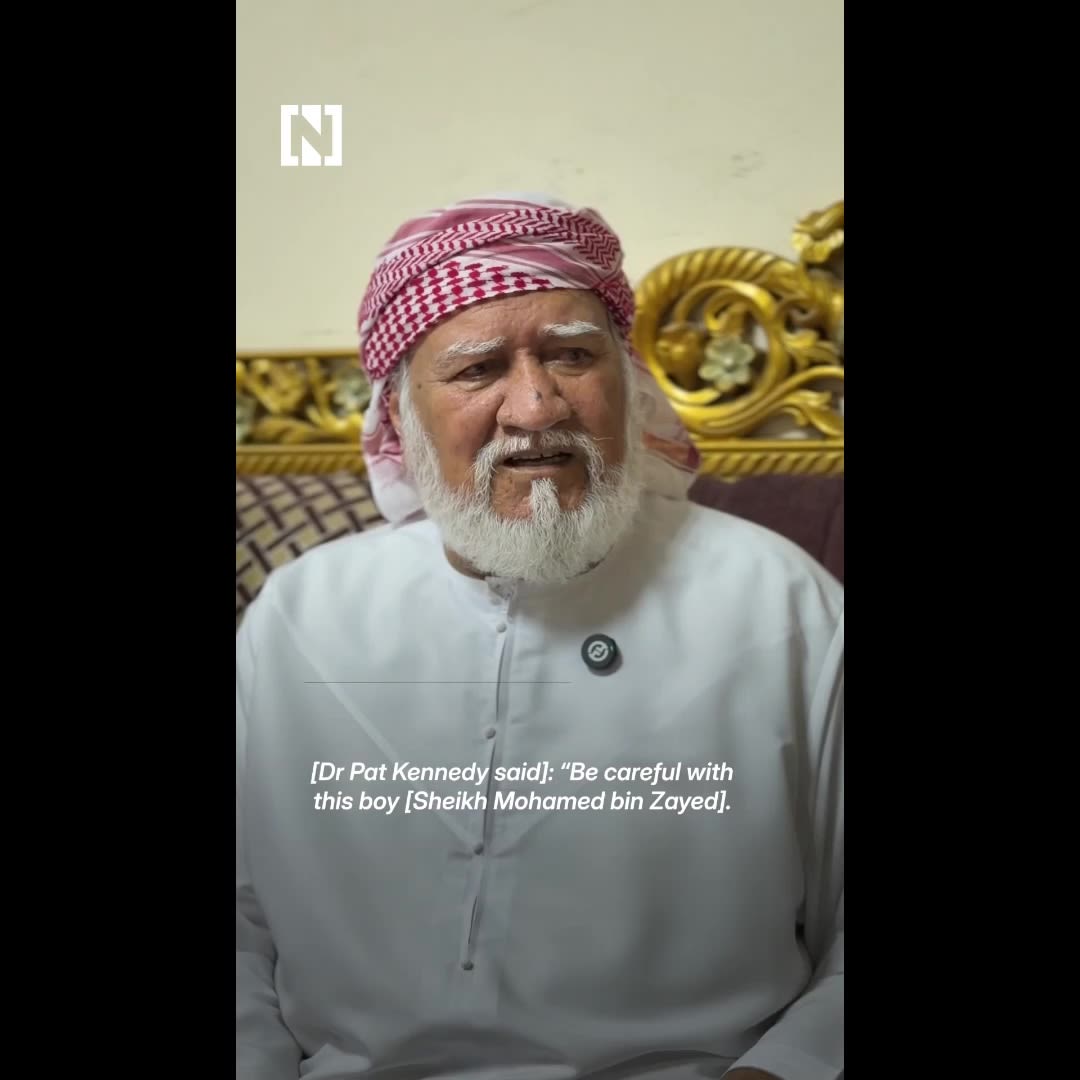
On Sheikh Mohamed in particular, he recalls Dr Pat Kennedy saying: "Be careful of this boy. He has power." Dr Pat Kennedy, Ibrahim said, added that Sheikh Mohamed would one day return to the hospital in a position of great authority.
Ibrahim adds that Dr Pat Kennedy made the comments as Sheikh Mohamed was playing Gallinah and Matou, a popular game played in the region using two wooden sticks of differing length where the winner is decided based on who can hit the smaller stick furthest.
More than 150,000 children have been born at the hospital since, including many members of the UAE leadership and prominent figures in public life.
Medicine before roads
The early years of the hospital were marked by improvisation and resilience.
Ibrahim recalls how Dr Pat Kennedy travelled to Dubai to obtain a generator at a time when electricity was not widely available.
“It was a very big generator,” he recalls. “But there were no direct roads. We had to go from Dubai to Abu Dhabi, then from Abu Dhabi to Al Ain.”
Dr Marian Kennedy on a trip to Dubai in the 1960s, before many of the roads between the emirates were paved
Dr Marian Kennedy on a trip to Dubai in the 1960s, before many of the roads between the emirates were paved
In the absence of basic infrastructure, the doctors adapted. They carried out procedures with limited equipment, relied on donations and gave blood themselves when needed.
More than six decades later, that same hospital is now one of the UAE’s leading maternity and neonatal centres – a transformation that reflects both medical advancement and continuity of purpose.
'We treat them as mothers, not patients'
Dr Hala Abu Subieh, a consultant in maternal foetal medicine, returned to the UAE after nearly two decades of training in Ireland and the UK, drawn by what she describes as a clear sense of purpose.
“What drew me to Kanad Hospital specifically is that it is a non-profit organisation,” she says. “They focus not just on delivering care, but on reaching out to those in need.”
Dr Hala Abu Subieh, a consultant in maternal foetal medicine at Kanad Hospital
Dr Hala Abu Subieh, a consultant in maternal foetal medicine at Kanad Hospital
Her work centres on high-risk pregnancies and she recalls one case involving a baby with a severe gastrointestinal abnormality that had gone undiagnosed elsewhere.
At Kanad, the team was able to identify the condition, closely monitor the pregnancy and make the decision to deliver early. The baby underwent surgery shortly after birth and survived. “They [the parents] were very appreciative,” she says. “They named the baby after me.”
Beyond clinical expertise, she emphasises a different approach to care. “We don’t treat mothers as patients,” she says. “We treat them as mothers who are really concerned about their baby.”
For Dr Fares Chedid, a consultant neonatologist who joined the hospital in 2018, the focus is on what happens after birth.
Trained in Belgium and Australia, he was drawn to Kanad by its history and model.
“It is one of the rare hospitals that is not for profit,” he says. “Every penny is reinvested in patient care, equipment and staffing.”
Dr Fares Chedid, a consultant neonatologist, joined Kanad Hospital in 2018
Dr Fares Chedid, a consultant neonatologist, joined Kanad Hospital in 2018
When he arrived, the neonatal intensive care unit was still developing. Today, it has grown into a highly specialised centre handling some of the most complex cases in the region.
Among its most significant achievements is the survival of extremely premature infants. “We are talking about babies born at 22 weeks,” he says. “The tiniest babies.”
These infants, often weighing between 400g and 1kg, face a high risk of complications and mortality, but outcomes at Kanad have improved significantly.
Centralising high-risk cases has also played a role. As one of only two tertiary referral centres in Al Ain, the hospital receives the most complex neonatal cases from across the region.
Dr Ralph Leo, chairman of the organisation that now manages Kanad Hospital, says the institution’s non-profit model is central to its success. “Our bottom line is always outcomes, not money,” he says.
Ibrahim with the 100,000th baby born at what was then named Oasis Hospital in 2018
Ibrahim with the 100,000th baby born at what was then named Oasis Hospital in 2018
His organisation, True Sojourners, took over the hospital during the pandemic. Before taking over, he sought the approval of Sheikh Mohamed.
“He told me something that made all the difference,” Dr Leo recalls. “‘We are family, never forget that.’”
Since then, the hospital has treated more than 5,000 Covid-positive mothers without a single death, while continuing to expand its services. Patients, he says, are drawn not only by quality but by legacy.
Full circle
For Ibrahim, now known to many as “Baba Ibrahim”, the hospital is more than a workplace. It is his life and he remembers Sheikh Zayed visiting regularly.
“Every time he came, he would give us money and ask each of us if we needed anything,” he says. “It was like your father and mother coming to visit you – someone who loved you unconditionally.”
Sheikh Zayed with his sons Sheikh Mohamed, middle, Sheikh Hamdan, right, and Sheikh Hazza in 1970
Sheikh Zayed with his sons Sheikh Mohamed, middle, Sheikh Hamdan, right, and Sheikh Hazza in 1970
He struggles to speak about the day the UAE Founding Father passed away. “Life stopped,” he says. But in the years since, he says he has seen that same spirit continue.
“When Sheikh Mohamed became the ruler, it was as if Sheikh Zayed came back to us,” he said. “The way he cares, the way he talks, the way he walks.”
Even now, when the President visits the hospital, Ibrahim finds himself running to greet him – just as he did decades ago.
“They are my family,” he says. “Everything I am today, everything Kanad Hospital is – it is because of Sheikh Zayed and Sheikh Mohamed.”
Ibrahim with his children and grandchildren at his home in Al Ain. Victor Besa / The National
Ibrahim with his children and grandchildren at his home in Al Ain. Victor Besa / The National
Baba Ibrahim worked for 57 years at Kanad Hospital. He never received a formal medical degree. But after a lifetime spent helping doctors, assisting patients and witnessing thousands of births, he says simply: “I am a doctor.”
 Built with Shorthand